
Music
Descend the winding ribbon of Outpost Drive late on an autumn evening, and the city below appears as an endless grid of white and amber light, vibrating with perpetual transit. The hum of the Hollywood Freeway is constant, a low drone carried upward on dry canyon air. Yet cross a threshold into a darkened living room, shut the heavy timber door behind you, and the scale of the world contracts instantly. The transition is not simply an absence of noise. It is an arrival into a different state of attention.
There is a singular, rarely discussed phenomenon that occurs in the first hour following a live musical performance inside a private home. Whether an informal trio gathering around a 1920s Steinway in the hills or a solo cellist playing beneath exposed douglas fir rafters in Pasadena, the departure of the final chord does not leave behind a vacuum. Sound does not vanish; it dissolves. The space itself seems to inhale the lingering frequencies, suspending them in the lime-washed walls, the hand-knotted wool rugs, and the quiet air. In that suspended hour, a room reveals its true character.
The weight of an ending
In public concert halls, the conclusion of music is met with immediate counter-sound. Applause erupts, program pages rustle, chairs scrape across concrete, and the crowd moves in unison toward exits and coat checks. The communal experience is fragmented before the vibration has genuinely died away. The architecture of a grand theater is built to project outward, to push sound toward an audience and release it cleanly so the next movement can begin unencumbered.
In a private home, the dynamic is reversed. The performance does not project away; it gathers inward. When the bow leaves the string or the damper pedal returns to rest, the silence that follows is thick with presence. Guests remain seated for several seconds longer than they would in an auditorium, hesitant to break the spell. In those few seconds, sound transitions from an auditory event into an environmental reality. You become acutely aware of the room’s proportions, the temperature of the air, and the texture of the materials surrounding you.
The architecture of acoustic memory
Every interior possesses what acoustic engineers call a reverberation profile, but musicians often speak of it in more poetic terms: the room’s memory. Certain rooms seem hungry for music, drinking in notes so quickly that a performance feels brittle and exposed. Others possess an acoustic generosity, catching high overtones and holding them softly against the ceiling before letting them fall.
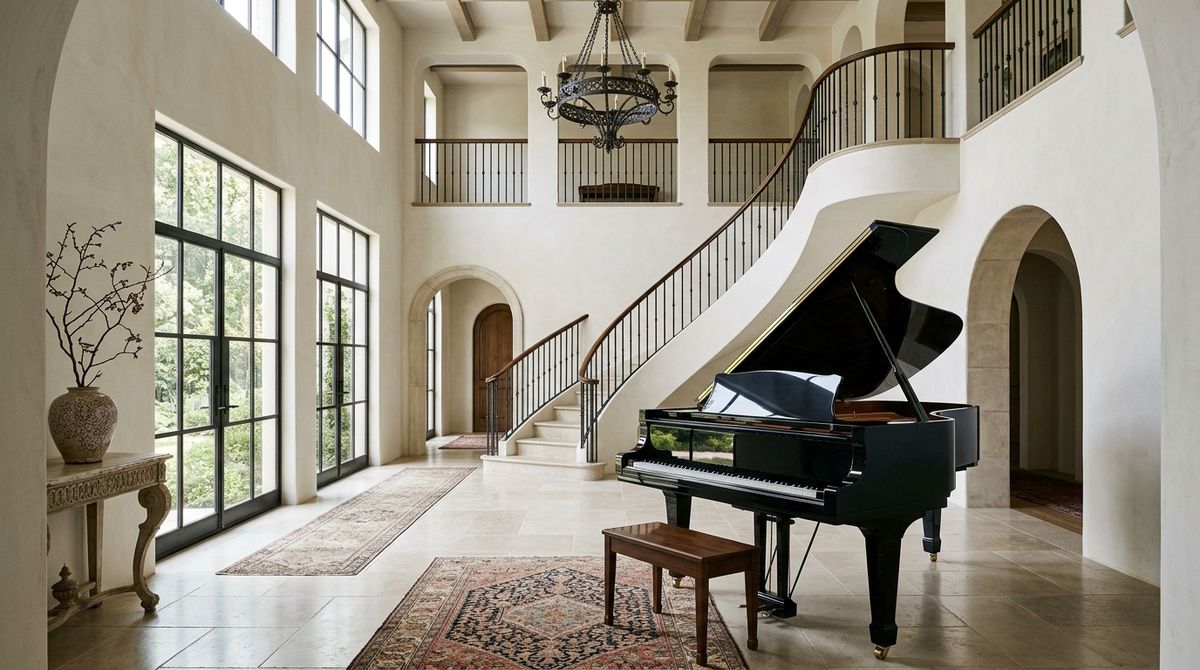
This acoustic memory is shaped by physical truth. Plaster applied over masonry holds a different resonance than drywall hung over steel framing. Open-grained white oak flooring yields a warmth that polished marble resists. When a space is designed with an intuitive understanding of resonance, it does not merely amplify music; it converses with it. An hour after a gathering has thinned and the front gate has clicked shut, those physical materials continue to settle. The room feels charged, much like the warmth that lingers on a stone terrace long after the sun dips behind the ridges of Griffith Park.
Materials that absorb and reflect
Modern luxury design has spent two decades pursuing clarity through subtraction: vast expanses of uninterrupted glass, continuous concrete planes, and soaring double-height volumes. While visually striking, these surfaces can be acoustically unforgiving. Without intentional counterweights, sound bounces erratically, turning conversation into clamor and music into a harsh reflection.
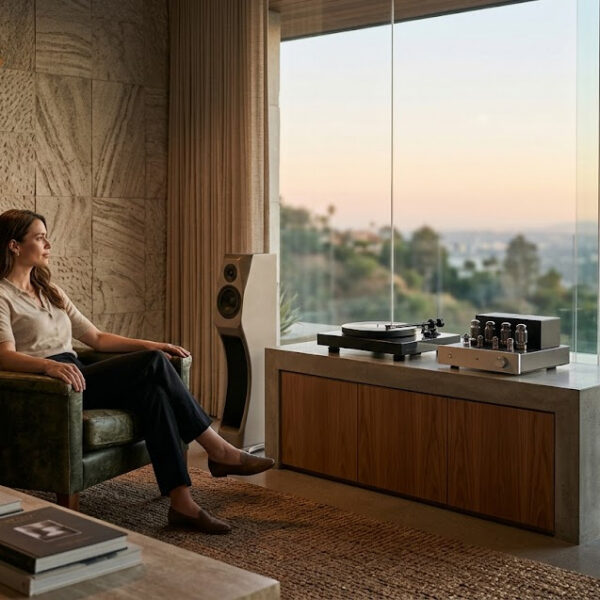
The homes that host music successfully understand the quiet interplay between hard and soft surfaces. They pair steel-framed pivot doors with deep-pile mohair upholstery. They balance floor-to-ceiling glass looking toward the Pacific with acoustic wood paneling, slatted ceilings, and floor-to-ceiling linen drapery that pools slightly on the floor. These elements do not deaden sound; they curate it. They allow a room to hold a cello’s lower register without muddiness, and they enable the subsequent silence to feel deep, textured, and profoundly grounding.
When the audience becomes the room
During an intimate performance, living bodies act as natural acoustic absorbers. Ten or fifteen people gathered in a salon subtly alter the room’s sonic profile, softening the edges of the room and anchoring the sound. The space feels warm and dense, an intimate pocket carved out of the wider urban sprawl.
When those people stand, embrace, and wander into the night, the room changes again. The sudden reduction in mass alters the natural frequency of the space. As you walk through the newly quieted living room, collecting a stray glass or adjusting a low lamp, your own footsteps carry a different weight. The room feels larger, more expansive, yet simultaneously intimate. It has expanded to accommodate the memory of what just occurred. This is the restorative heart of domestic architecture: its capacity to transition seamlessly from a stage for shared communion to a private sanctuary for solitary decompression.
The luxury of deliberate silence
In a metropolitan landscape defined by ambient noise—sirens along Sunset, helicopters tracing the coastline, the ceaseless hum of air handling units—pure silence has become the rarest amenity. True silence, however, is not a void. Absolute deadness feels unnatural, even unsettling, like entering an anechoic testing chamber.
What the discerning ear seeks is intentional quiet: an acoustic envelope where interior sounds are gentle and external disruptions are held at bay. The hour after a performance highlights this distinction. You hear the slow, melodic ticking of an antique clock, the soft hum of the refrigerator, the rustle of eucalyptus leaves against the glass outside. These subtle sounds do not disturb the quiet; they define it. They remind you of the protective barrier your home provides against the world outside.
Designing for the aftermath of sound
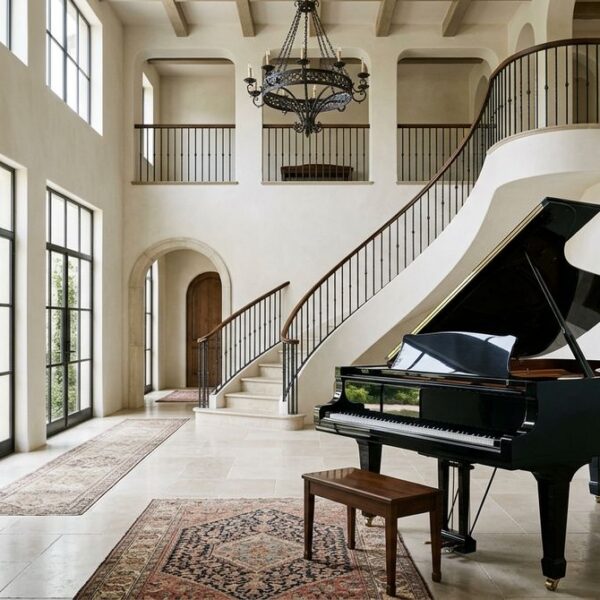
To design a home for music is not simply to install hidden speakers or construct a dedicated media room with dampening foam. It is to consider how living spaces breathe through every phase of sound and quietude. It begins with sightlines and flow, ensuring that a piano sits not as a decorative curiosity in an unused corner, but as the natural anchor of the main living pavilion.
It involves considering the journey of sound through adjacent rooms. Does the music drift gently into the kitchen, or does it echo sharply down hallways? Can someone find a quiet reading alcove in the library while chamber music fills the adjacent living room? At The Durkovic Group, we frequently view a residence through this multisensory lens. A truly exceptional property is never defined by square footage or finishes alone; it is defined by how effortlessly it holds the rhythms of daily living, accommodating vibrant cultural gatherings one moment and deep, restorative solitude the next.
The home as a listening vessel
As midnight approaches, the house returns fully to rest. The lid of the piano is lowered, resting on its felt cushions. The cello stands silent in its hard case by the hearth. The lingering warmth of conversation has settled into the upholstery, and the air has cooled.
Step back outside onto the terrace, and Los Angeles continues its ceaseless rhythm, lights twinkling from downtown to the coast beneath an indigo sky. The contrast is complete. The city moves at its own frenetic pace, but behind you, the room remains still. It holds the imprint of the evening’s final phrase, suspended in the grain of the wood and the quiet expanse of the plaster—a private reminder that a home, at its highest expression, is not merely an enclosure from the elements, but an instrument for living well.