

Community
Just past six in the evening, the relentless kinetic energy of Los Angeles begins to soften. The steady hum of the Arroyo Seco Parkway recedes into a low, ambient murmur as tires cross over brick-paved aprons and turn into the deep shade of old-growth camphor trees. Out on the broader avenues, the city remains suspended in motion, commuters chasing taillights beneath a sky bruised with indigo and pale apricot. But turn two corners into a Pasadena side street, and the cadence changes entirely. The air drops three degrees. The rush dissolves into something quiet, considered, and distinctly human.
It is in this precise hour, balanced between the demands of the working day and the quiet seclusion of night, that a collection of individual residences transforms into something far more profound: a neighborhood. This transformation does not announce itself with organized fanfare or deliberate intention. It occurs through small, repetitive gestures. Belonging, it turns out, is not an architectural feature or a line item on a deed. It is a slow, accumulated rhythm practiced on the sidewalk at dusk.
The Subtle Deceleration of Dusk
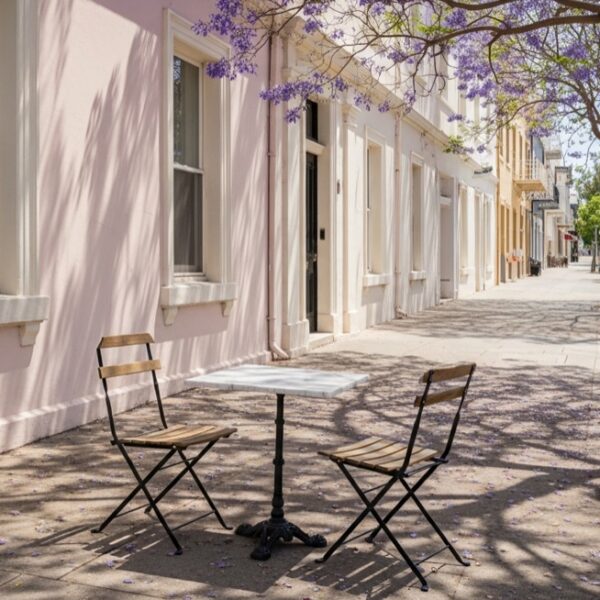
The transition begins with sound. The heavy thud of a solid oak front door swinging shut. The rhythmic, measured sweep of a push broom clearing jacaranda petals from a wide driveway. Down the block, the dull metallic rattle of a garden hose being unspooled across damp dichondra signals the start of the evening watering. These are not chores in the utilitarian sense; they are grounding mechanisms. They mark the boundary between the public self that negotiates the sprawling metropolis and the private self that tends to the immediate perimeter of home.
In many modern developments, arrival is engineered for absolute isolation: an automated gate swings open, a vehicle disappears into an subterranean bay, and an elevator lifts the inhabitant directly into private air space. But along these historic foothill corridors, arrival remains an exterior event. One steps out onto crushed gravel or warm flagstone. The evening breeze carries the sharp, medicinal tang of eucalyptus drifting down from the Arroyo alongside the sweet citrus notes of blooming pittosporum. You are immediately outside, exposed to the ambient life of the block, invited to slow down before you ever step indoors.
The Sidewalk as an Unplanned Living Room
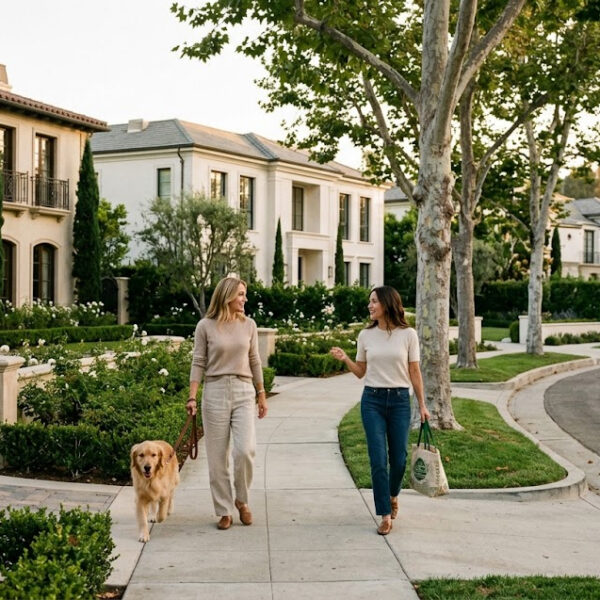
As the sun settles behind the ridge of the San Rafael Hills, the sidewalk assumes a civic role that urban planners spend decades attempting to manufacture. Without any formal invitation, people emerge. The evening dog walk serves as the universal passport to the public realm—a slow, meandering circuit that moves at the speed of an inquisitive terrier pausing at every river-rock border.
Here, interactions are governed by an unwritten etiquette of low pressure. Neighbors lean against low clinker-brick walls, exchanging observations on the coming heat wave, the stubbornness of old plumbing, or the sudden appearance of coastal fog rolling across the basin. These are brief, gentle encounters. They demand nothing, yet they construct a durable web of familiarity. To know the names of seven dogs and their respective human companions is to possess a quiet, unquantifiable security. It is the understanding that you are recognized, that your presence within this landscape matters to the people who share its edges.
The Architecture of Soft Boundaries
This effortless communion is supported by a specific architectural dialogue that has defined Pasadena for over a century. Unlike neighborhoods fortified behind austere privacy hedges and defensive perimeter walls, these side streets celebrate the art of the gradient. Space moves thoughtfully from public to semi-private, and finally to sanctuary.
Consider the deep front porch of a Craftsman bungalow or the broad terrace of a 1920s Spanish Revival home. These structures were conceived not as decorative facades, but as observational perches. Positioned several strides back from the sidewalk and elevated just a few feet above grade, they create an elegant zone of optional sociability. A homeowner sitting on a porch with an open book and a glass of chilled wine is neither entirely sequestered nor wholly exposed. They are part of the streetscape, an appreciative spectator to the neighborhood’s evening tide. The architecture itself invites connection while respecting solitude, establishing boundaries that are soft, porous, and inherently welcoming.
Shared Rhythms Without Shared Agendas
What makes these evening routines so remarkably restorative is their lack of an agenda. In an era when our social lives are largely curated through screens and calendar invites, the unscripted encounter feels increasingly radical. On an ordinary Tuesday at seven o’clock, nobody on the block has gathered for a meeting or organized a block party. Yet the collective presence creates a shared atmosphere of profound calm.
A neighbor pauses to return a pair of heavy brass pruning shears across a low hedge. Two parents push strollers side by side, their conversation punctuated by the squeak of rubber wheels against aggregate concrete. Further down, an elderly resident steps out to retrieve the evening paper, pausing to watch three children ride balance bikes in loose circles across the cul-de-sac. These moments cost nothing and require no performance. They provide an antidote to the frantic velocity of modern life, anchoring inhabitants in an enduring sense of place that square footage alone could never supply.
The Sensory Palette of the Foothills
Place identity is fundamentally sensory, and the Pasadena evening possesses a signature that is impossible to replicate. As the daylight drains away, the San Gabriel Mountains lose their jagged daytime contours, flattening into an immense, velvet silhouette that cradles the northern horizon. The mountain mass acts as a thermal anchor, pulling cool, crisp air down through the canyons and sweeping away the lingering warmth of the valley basin.
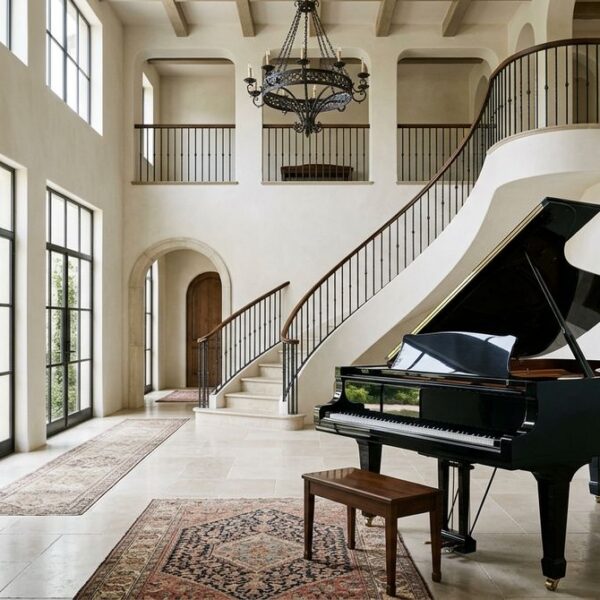
Windows throughout the street are unlatched and pushed open to catch the descending draft. The interior world begins to spill out into the twilight: the mellow resonance of a piano practicing Chopin through a set of open French doors, the rhythmic clink of flatware against ceramic plates on a side patio, the aroma of garlic gently caramelizing in olive oil drifting from a lit kitchen. The street becomes an orchestra of quiet living. You are reminded that luxury is not merely the possession of fine materials, but the privilege of existing in an environment where sound and scent and air are in gentle harmony.
Why Belonging Cannot Be Manufactured
In the contemporary real estate landscape, endless marketing materials promise community as if it were a turnkey appliance. Amenity decks, shared lounges, and curated resident mixers attempt to simulate human connection through programmed experience. Yet true belonging remains stubbornly immune to corporate design. It cannot be delivered at escrow, nor can it be sustained by an app.
Real community requires friction-free physical terrain, mature trees that temper the climate, and, above all, the patient passage of ordinary time. It flourishes where people feel safe enough to linger and comfortable enough to be seen in their everyday unpolished states. A neighborhood becomes real when its inhabitants stop treating their homes merely as financial assets or private retreats, and begin treating the surrounding street as an extension of their domestic world. It is the realization that home does not end at the property line; it encompasses the canopy overhead, the stone beneath your feet, and the familiar wave of the person watering their hydrangeas across the lane.
The Art of Living in Place
Modern luxury is less about showing off and more about how a space makes you feel. At The Durkovic Group, our perspective has always been guided by this fundamental truth: the value of an exceptional property is indivisible from the quality of life it enables beyond its walls. While soaring ceilings, hand-troweled plaster, and museum-grade finishes provide daily pleasure, the true measure of a sanctuary is its capacity to connect you to an authentic way of living.
When you choose a home on a street defined by deep roots and reciprocal care, you are not simply acquiring square footage; you are stepping into an ongoing narrative. You are choosing to participate in an ecosystem where evening walks are cherished rituals, where historic trees provide collective shade, and where the transition from day to night is celebrated with quiet reverence.
As the final light fades from the western sky, the streetlamps flicker to life, casting pools of warm amber onto the pavement beneath the camphors. Front doors close gently one by one. The porch lights glow softly through the deepening dark, keeping watch over the quiet street until morning. Miles away, the freeways continue their ceaseless hum, but here, beneath the shelter of the foothills, the day has ended exactly as it should: in peace, in balance, and in quiet belonging.